



















Other Games & Puzzles
Last updated February 18, 2024
There are many games that are not truly abstract games but have a strong strategy/skill level, so are likely to appeal to abstract players. They certainly appeal to me.
Dice Games
Surely Backgammon is the dice game with most skill/strategy. A player's turn relies on the random throw of a pair of dice, so when first learning about the game, it feels like just a game of chance. However, a stronger player will make better use of their dice rolls, good or bad, to adapt their strategy accordingly. For example: Play defensively to minimise the chances of your pieces being hit or maybe blitz your opponent to hit every one of their blots. Prioritise creating a prime to trap your opponent in your home board over all else? When to race for home if ahead and when to create a 'back game' when behind. There are also opening moves/ideas that need to be assimilated - nowhere near as extensive as chess, but necessary. In a close endgame, there are bearing off techniques which will help. When the doubling die is introduced and matches are played (e.g. first to 7 points), rather than individual games, the skill level rises significantly. I have seen it written that there are more skill levels in Backgammon than in chess! An article on the skill levels in games is in preparation . . .
I have played Yahtzee and Shut the Box. Fun, and there is some skill in play, but not really enough to consider these as strategy games.
Searching online for dice games with strategy threw up lots of board game suggestions, often released in recent years. I have not played these, so I can't really comment. If you have such a game that you love, with a large strategic element, please let me know.
War Games
I was introduced to hex war games in the late 1970's by Mike A., a pupil at the school where I taught. In particular SPI's Napoleon at Waterloo, an introductory game for the genre.
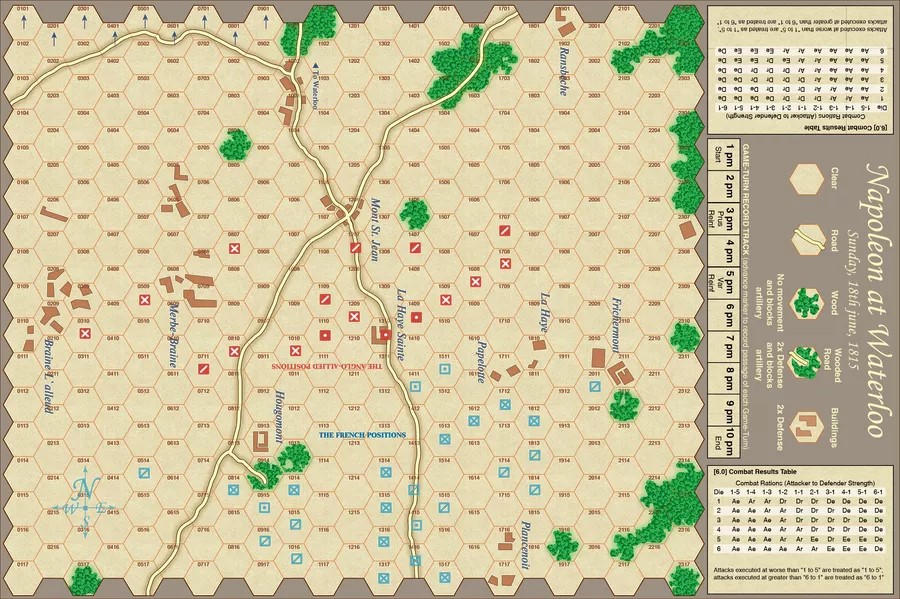
Clearly, there is a very strong theme, so not abstract. Indeed it is a simulation game of that battle. There is full information for the players who have full control of the movement of their pieces. A random element is introduced by using dice for combat, but the stronger force is given a greater probability of winning an engagement by the use of a combat resolution table. Being critical, there are many pieces to move on a turn, so perhaps too much down time for the opponent - or perhaps that's just against me, as I tend towards analysis paralysis! There are plenty of strategic decisions to make. For example, do I try a flanking manoevre with my cavalry, or try to punch through the middle of my opponents lines with artillery? The dice add spice and fun to the game - the best commander will allow that a particular engagement might go against them.
Another war game that I really like, but without hexes on the board, is Task Force.

It is an East vs West battle with each side having an atomic bomb that they could use once in the game!! I played it against my cousin Martin as a teenager in the 1960's but only recently acquired a copy and played again. It is a lighter game (despite the atom bombs) than hex wargames, but strategy is still paramount. A random element is introduced by a special die used to determine whether you can move 1 / 2 / 3 pieces on your turn. It is true that a beginner can win a game using a poor strategy with very lucky die rolls (and has recently done so!), but unlike chess, if you are clearly losing, the die gives you hope that you might recover if you play well. Rather like Backgammon, the winner is likely to have made best use of the good/bad rolls. It's a fun strategy game to play, though difficult and pricey to acquire now.
Puzzles
When I initiated EAG I would not have expected to include puzzles. However, I am going to!! A puzzle can be thought of as a game between the setter and the solver. However, I find that rather tenuous and I am going to start including puzzles that I really like just to collect the information I have about them in this online storage facility. Also, they are likely to appeal to abstract game players.
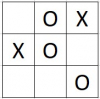
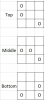
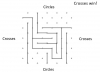
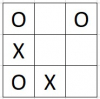
Firstly, a puzzle for which I have been motivated to write my first ever puzzle article.
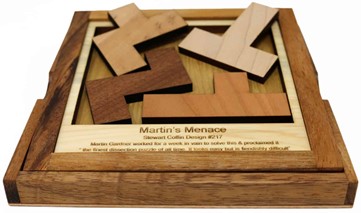
Here is link to its pdf file Martin's Menace.
Recreational Mathematics
Similar to puzzles, I would not have expected to include fun mathematical problems/puzzles in EAG. However, why not! I already have lots of documents on recreational topics filed on my computer. It should be an easier task than writing abstract game articles from scratch to edit the best of them and publish here. Likely to still be a slow process though . . . .
The factorial 365! = 1 x 2 x 3 x 4 x 5 x 6 x 7 x . . . 363 x 364 x 365 is a huge number.
It ends in many 0's - the trailing zeros. How many trailing zeros are there in 365! ?
A harder follow up question is what is the rightmost non-zero digit?
When you have had a go yourself, here is my article which gives solutions - 365! Problems
Comments
DrDave
23 November 2021 - 3:32pm
Permalink
Skill levels
I read a Neil McDonald article -- quoting someone else -- I think in the New Statesman, years ago, and from that I remember the skill levels were something like:
7 Backgammon
11 Chess
14 Bridge
21 Go
See also:
https://thegammonpress.com/comparing-games-skill-chance/
...Which gives different numbers -- maybe my memory is amiss, or it's a different set of estimates
I think one original paper was held at https://www.lri.fr/~teytaud/depth.pdf but link rot has claimed it