
Hex
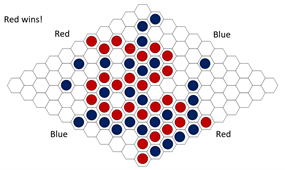
If talking to general game players, Hex is my prime example of a non-trivial abstract game. Its rules are so easy to learn, but its strategy is deep. It is a 6/6 great game for me. The only downside is the lack of availability of physical sets!
Rules
With the picture above as an example, take turns to place a counter of your colour on any vacant hex, with the aim of joining up your sides of the board with a contiguous path. Easy!!
See full details - Hex Rules.pdf.
Background
Hex was invented in 1942 by polymath Piet Hein, who also invented the Soma cube. Apparently, it was independently invented by mathematician & game theorist John Nash, of the film A Beautiful Mind fame.
I first met the game at school in the 1960's, in Martin Gardner's Mathematical Puzzles and Diversions book. I didn't get to play it at that time, but I loved the Gardner article in which he explains that a draw is not possible and there is a winning strategy for the first player, even though no-one knows what it is!
Equipment
- I read that the game was published in 1952 by Parker Brothers, but I have not seen a set.

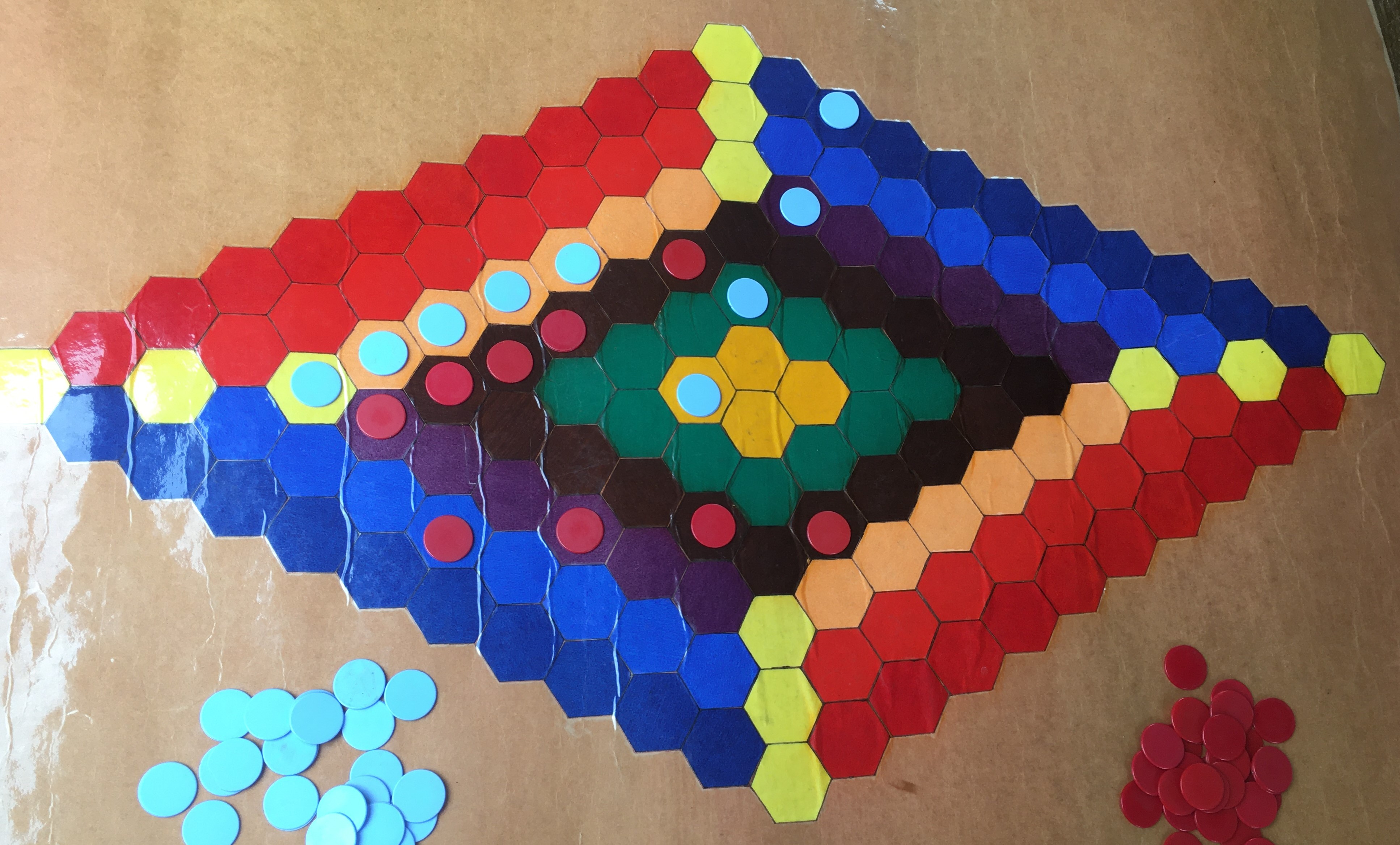
- At the college where I trained for my PGCE, they had a student shop with resources for teachers, mainly for young children. I purchased several packs of coloured hexagon stickers which I used to make a rainbow hex board on A1 sized card. I also bought enough packs of plastic counters (a mix of 6 colours in each pack) to have 60 red and 60 blue. This has been my main Hex set for both school and personal use ever since!
- I have a travel set (published by Just Games - now defunct) with small magnetic discs - very fiddly to play with.

- In 2020 I bought a modular set from hexboard.com, but I have yet to play anyone using it due to Covid restrictions! The stones are nice and the modular board pieces fit together to make different sized boards (and some puzzles)
- Of course, you can play using pens on a paper board - two colours, or O's & X's. Here is an A4 Hex board I created in Word - Hex Board EAG.pdf and here are 4 smaller boards on a single sheet from a Board Game Geek member - Hex | hex11x11.pdf | File | BoardGameGeek.
Beginner's Strategy
Much as I think it is a brilliant game, I have no claim to any great knowledge or skill in Hex. Over the years, I have mostly played school pupils and whilst they can be really sharp in play, they lack the experience and maturity to explore the game deeply. When teaching the game to a newcomer, I always resisted imparting my limited knowledge and instead let them deduce basic ideas themselves by losing to me! (I have been criticised with this approach, but I will defend it vigorously for all games and I have a similar style with mathematical puzzles/problems.) Here are a few common early ideas that develop naturally . . .
- Beginners tend to feel they should attempt to extend an existing chain by playing directly at its ends. e.g.

Yes the red counters are safely connected, but it is slow to create and very easy for Blue to stop. Beginners often seem to be oblivious (for a while) to my play which does not do this! - The first useful strategy idea can be see here.

The red counters are really connected, even though they do not appear so. The left two red counters are joined by 2 empty hexes. If Blue plays in one of those, Red just plays into the other! The same for the right two red counters. It is a waste of moves to actually join the red counters, unless Blue plays to force you to do so. It is much quicker to cross the board by building a chain this way. It does not have to be straight, but be careful not to turn too sharply, as Blue could then use a single counter to simultaneously disrupt two pairs of linking hexes. - To stop this tactic from going straight from one side of the board to the other, and winning, Blue needs to start making their own blocking chain, to cut across it, but must start a few hexes away from the end of Red's chain.
- A first counter near the middle of the board is a stronger play than one near an edge. That the centre of the board is important is commonly true of many abstract games, particular chess.
- How near does a counter need to be to the edge of an empty board to be certain to be able to join it to the edge . . . . ?
As I have already mentioned, I am not a strong player, though I did teach myself a bit more than the above - for example, short vs long diagonal and the use of what I now know are called ladders. So, I am going to give links to the strategy ideas of others. I wish that I had read, assimilated and could remember all of the info below!
- When I was young, I could find no books to help me play Hex (but hundreds for Chess!). In 2018, I bought Hex Strategy by Cameron Browne. Published in 2000, it is the first serious book about Hex strategy - surely a must for anyone who wants to play Hex really well, though it is not cheap, even for a used copy.
- Published in 2019, I have only just discovered (in 2022) Hex: A Strategy Guide by Matthew Seymour. This is an online book which is free! It has the tremendous advantage that all of the illustrative diagrams are interactive - you can experiment and play out from a given position, with the use of video control buttons! Oh, how I would have loved that facility for chess when I was attempting to improve.
- As well as the book above, Matthew Seymour has also compiled a site of 500 Hex Puzzles - it's brilliant! These are graded as Tutorial / Beginner / Basic / Intermediate / Advanced. Looking at just a snippet of a game board, you decide on your play and a computer AI plays your opponent until success or failure. As in his book, there are video control buttons to aid analysis. Unique, in my experience, is the option to not play a piece. Usually, you are trying to connect your pieces, but if they are already connected (albeit indirectly) then this would be a wasted move in a game. If you pass, the computer plays a move for your opponent and forces you to prove that you knew how your pieces were connected.
- Other good stuff here Strategy - HexWiki, and the HexWiki site has lots of more general info about Hex.
- The game cannot end in a draw.
The only way that I can prevent my opponent from winning by completing their path is to complete my path and win myself! - There is a winning strategy for the first player.
Outline proof: - Since there cannot be a draw, either the first or second player must have a winning strategy. However, it cannot be the second player because the first player could place a counter on a random hex (and this extra counter cannot be a disadvantage) and then steal the second player's strategy. (Should this involve playing on the first hex which he has already used, he just makes another random move.)
Mathematicians will recognise this as an existence proof using the technique of Proof by Contradiction. - . . .
Online Play
- . . . .
References
- Martin Gardner - Mathematical Puzzles & Diversions, Pelican Books 1965, Chapter 8 The Game of Hex: - Intro; history; rules, basic strategy; theory; problems; . . .
The rest of the book was my introduction to recreational mathematics. Briliant, even though a little dated now, as are his other recreational maths books - . . . .
- Hex (board game) - Wikipedia Lots of information and advanced stuff here.