
OXO 3-D
Last updated May 13, 2022
Noughts and Crosses easily extends to play in 3 (or more!) dimensions. Various rules can be used, with pros and cons for each - first to get a single line wins; first to get a line loses; play a set number of pieces then move pieces to adjacent spaces; and so on . . .
- 3x3x3 Cube
I first played this as a teenager at school using just pencil & paper and 3 copies of a 3x3 board - top, middle, bottom, as follows: -
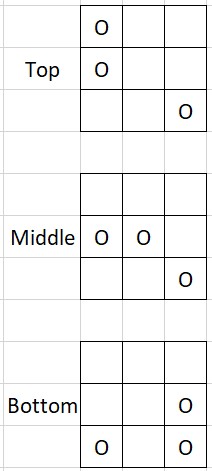
The image shown displays 4 completed lines of O's. With practice, it is not too hard to 'see' the 3-D cube.
The game is meant to be 3 dimensional, so why not have a 3 dimensional board?! There have been several commercial sets available - here are mine.
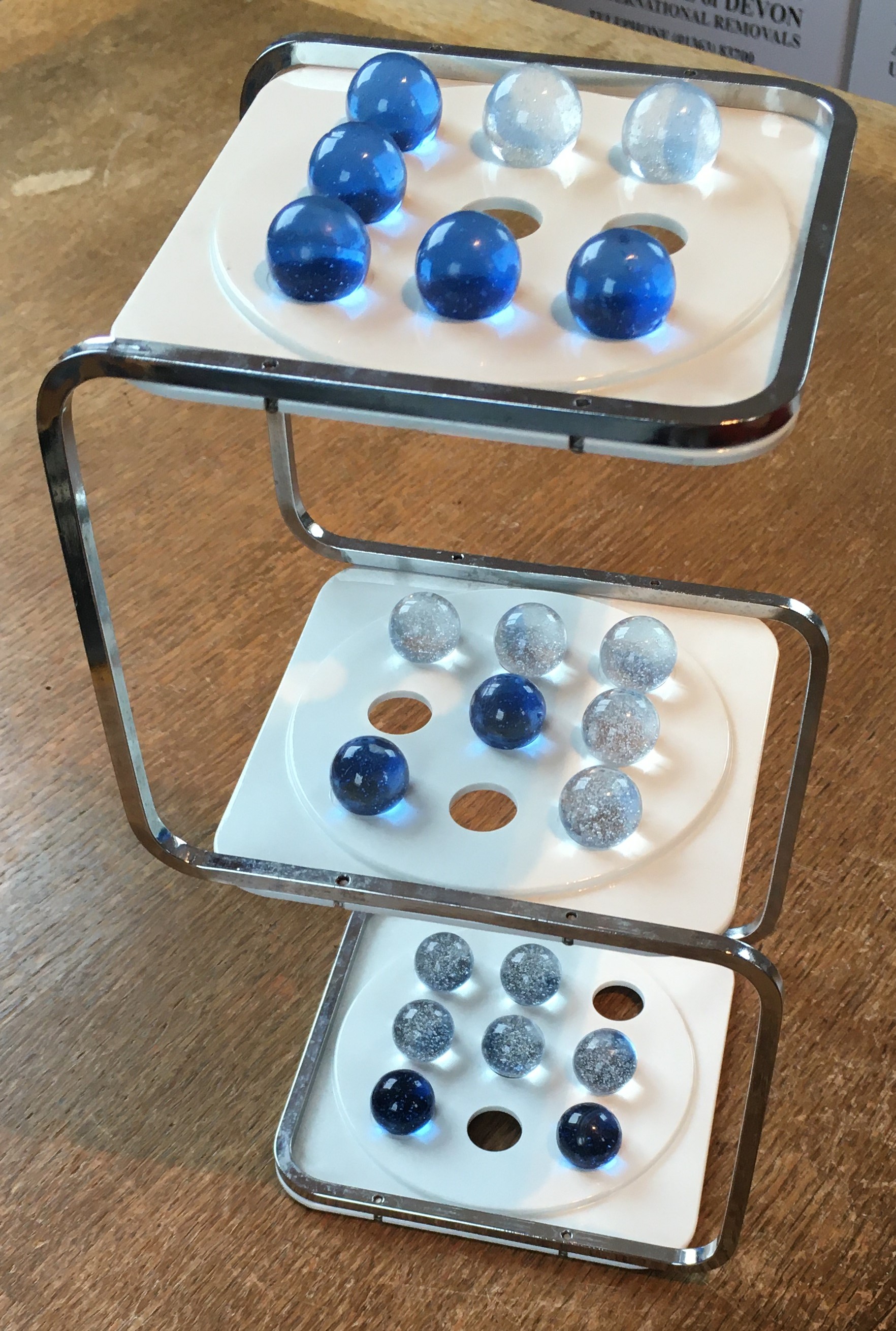
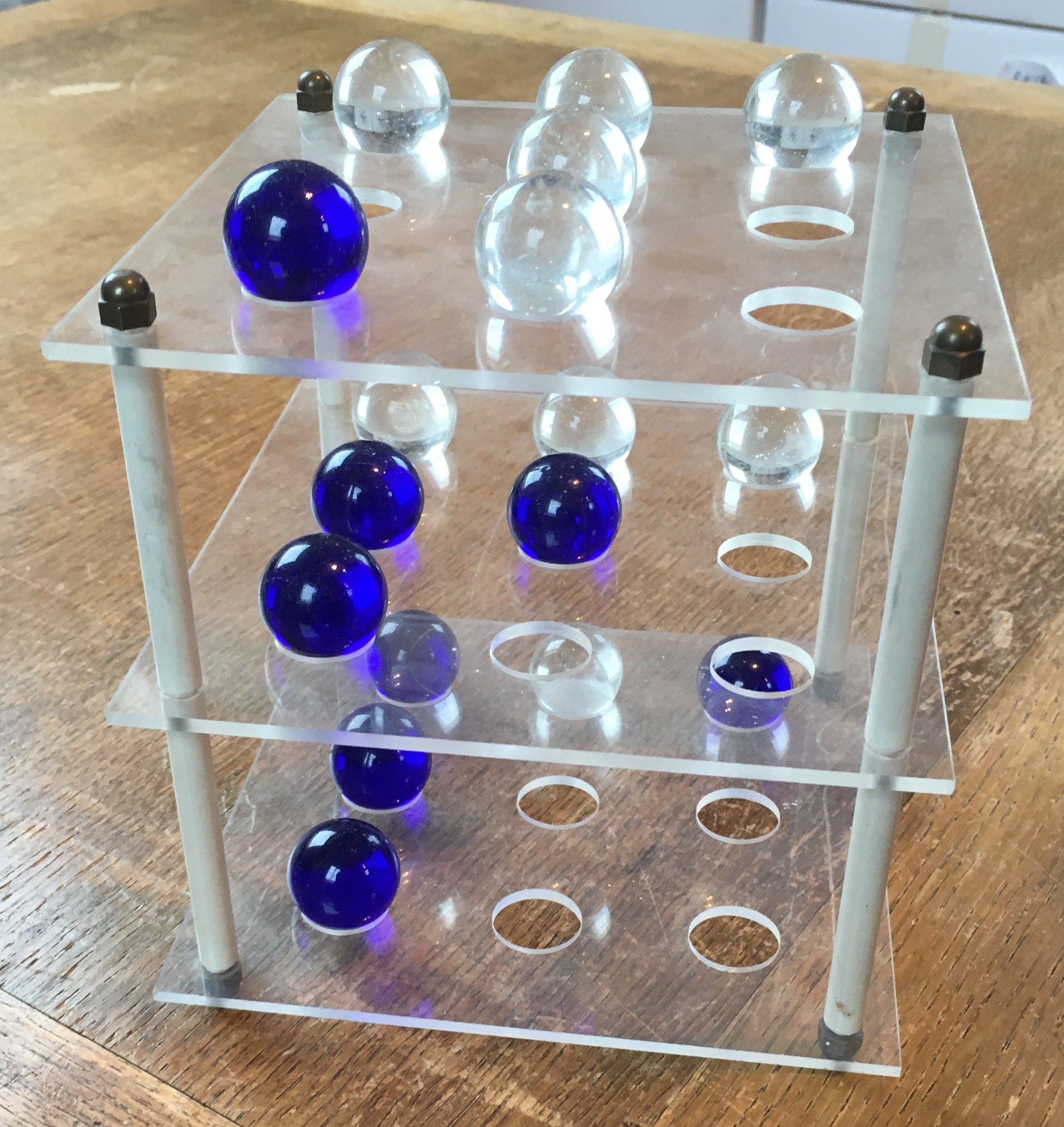
In both pictures, every marble is in a completed line.
I like the version of the rules where players continue playing pieces until the board is full (almost) - 13 marbles each. The player with the most lines wins.
- 4x4x4 Cube
This version was marketed under the name Qubic. As can be seen from my set, in the picture below, the pieces come in 3 colours!
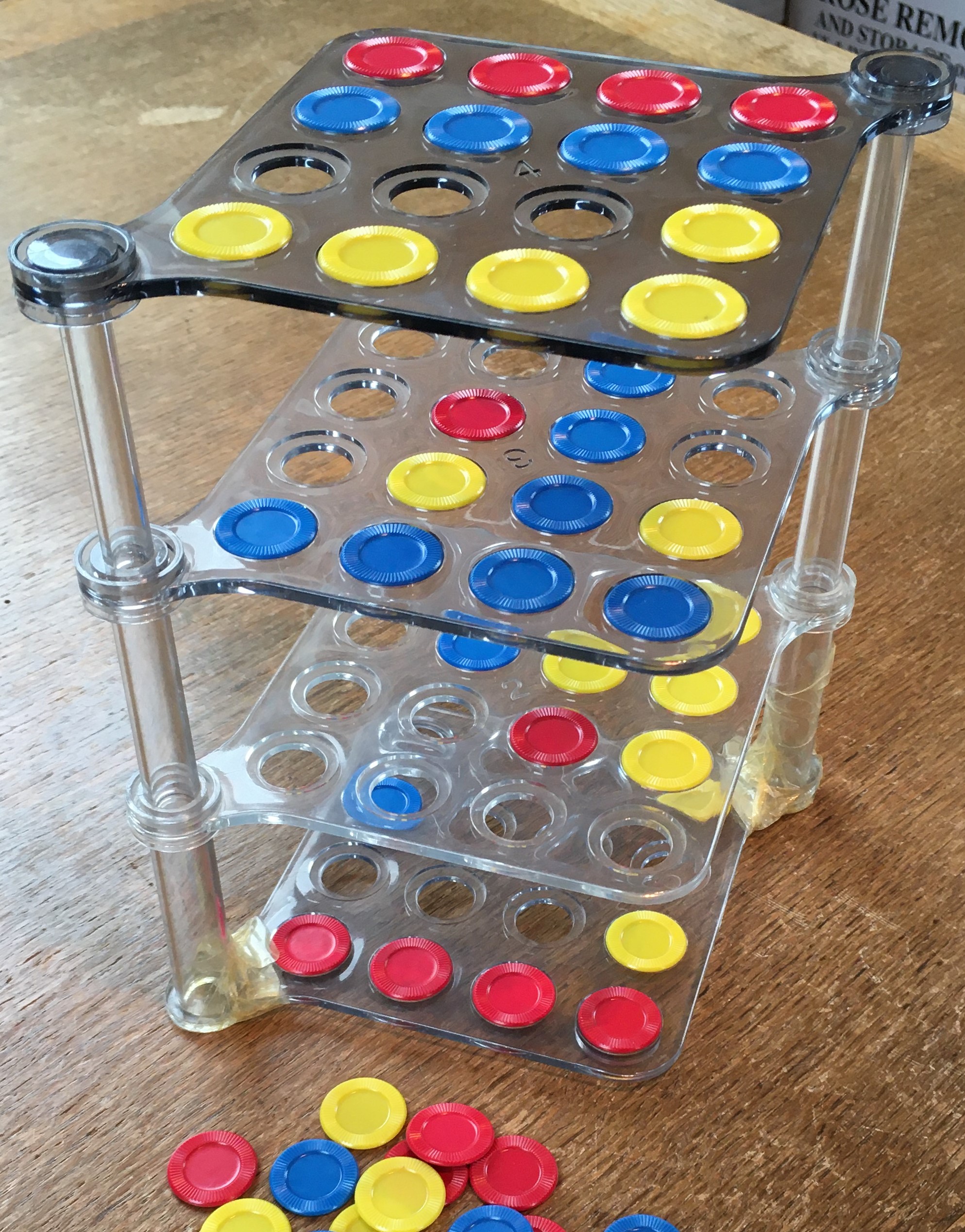
This allows the basic game (to be the first to make a line of 4) to be played by 3 players, as well as 2!
For the 2 player game (from Wikipedia) the existence of a winning strategy was proven but without actually presenting such a strategy, by Eugene Mahalko in 1976. A complete first-player-win strategy, was published by Oren Patashnik in 1980, involving a computer-assisted proof that consumed 1500 hours of computer time. I believe this could be replicated in no more than a few hours computing time today, maybe much less?
Pencil and paper can again be easily used to play this game in 2-D, using 4 copies of a 4x4 board, but here is a 2-D magnetic version that I found.
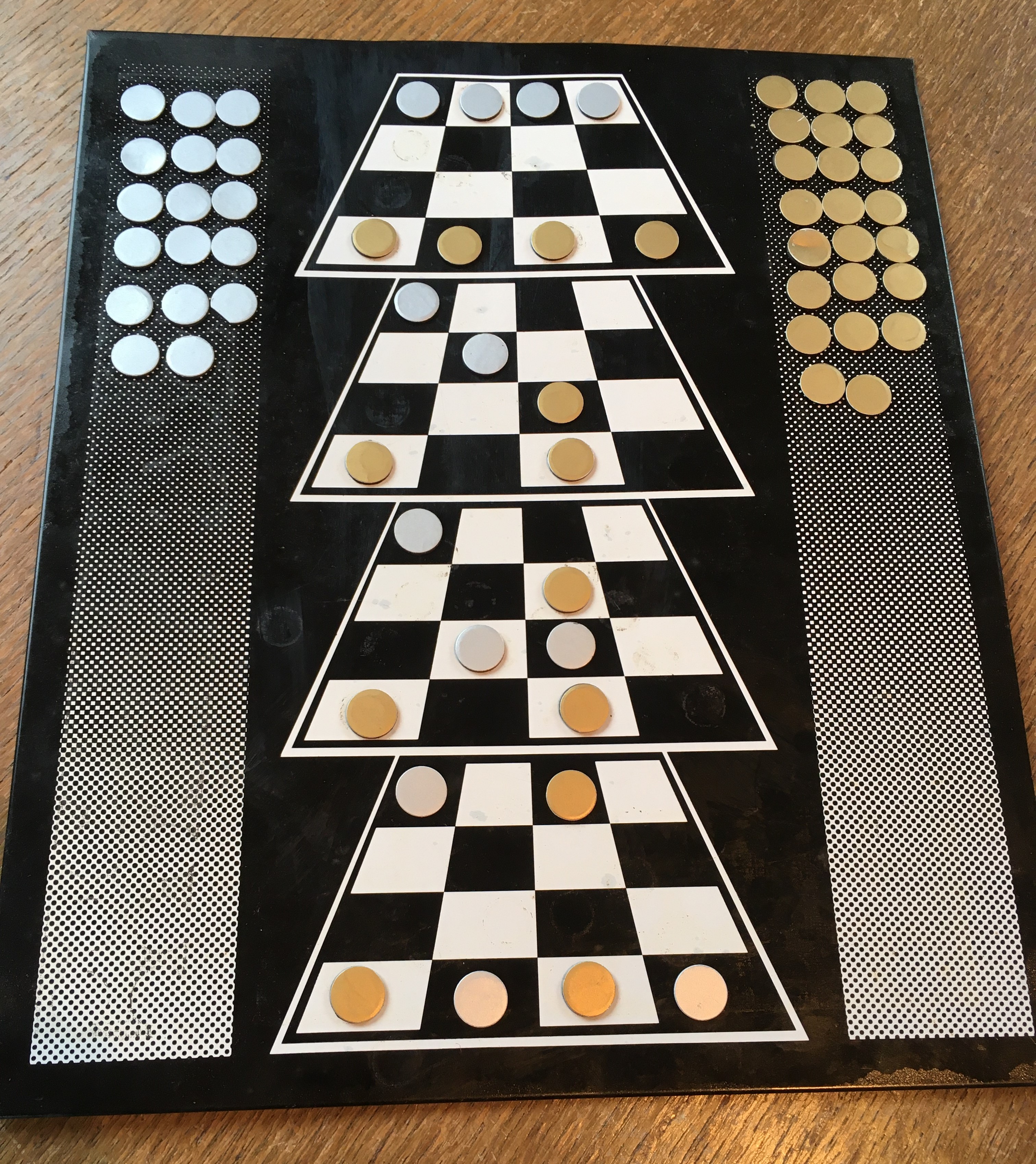
I think the perspective on the 4 layers help to visualise the 3 dimensional complete lines.
- 3-D with gravity
Just as a 2-D OXO board was rotated vertically, to become Connect Four, there are various 3-D OXO sets available where the pieces are dropped down onto previous pieces that have been played. Here are my sets.
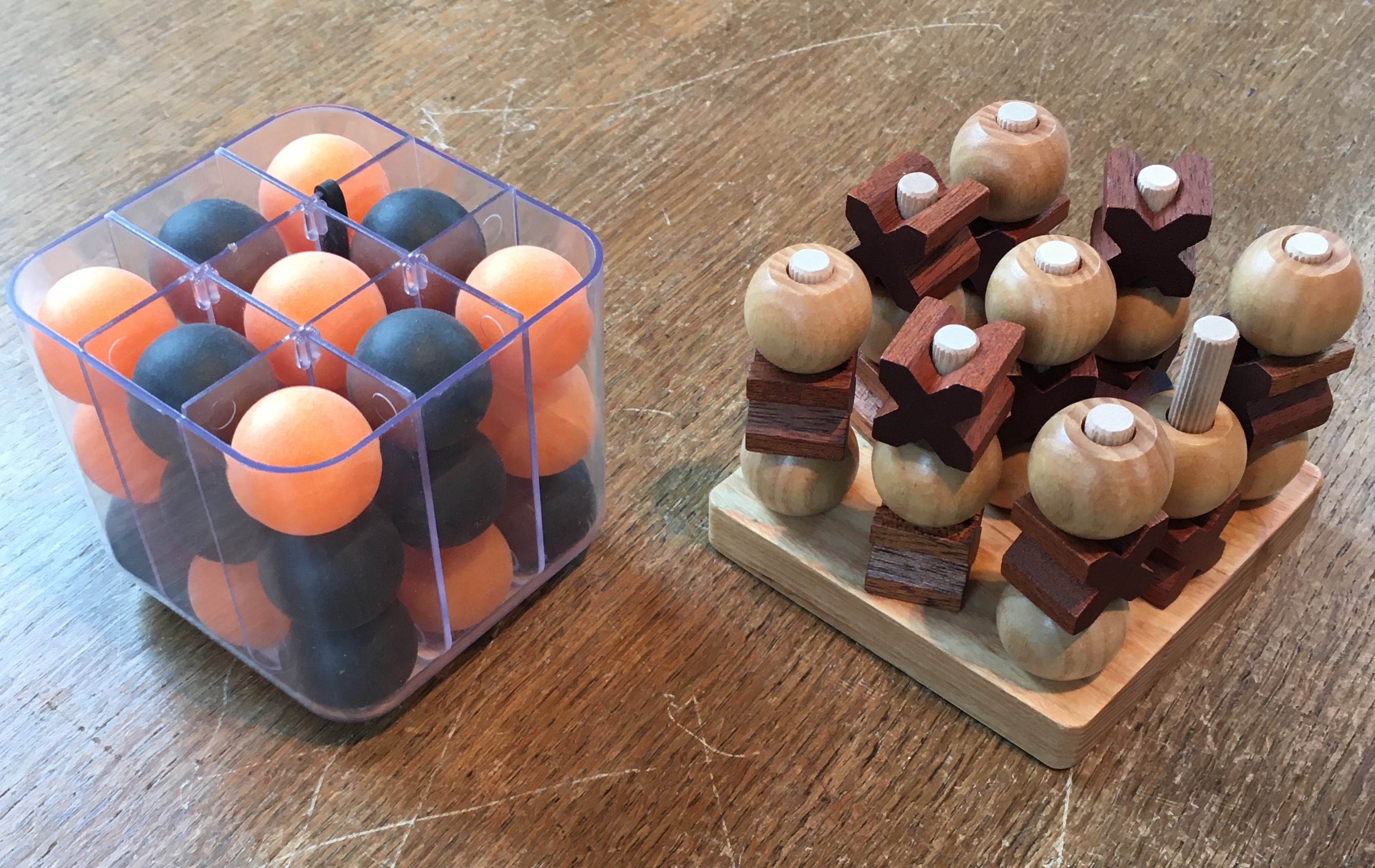
I have never played these!
- 4 Dimensions!
The trick used to play 3-D OXO using pencil and paper and 3 copies of a 3x3 board easily extends to 4 dimensions.
For 3x3x3x3 you need an array of 9 copies of a 3x3 board.
For 4x4x4x4 you need an array of 16 copies of a 4x4 board.
Anyone interested in 4-D OXO is likely to be able to work out complete lines for themselves, without me giving an example, though 'seeing' them well enough to be able to plan a strategy to win the game at the same is another matter . . .
More information can be found at 3D tic-tac-toe - Wikipedia