
Fanorona
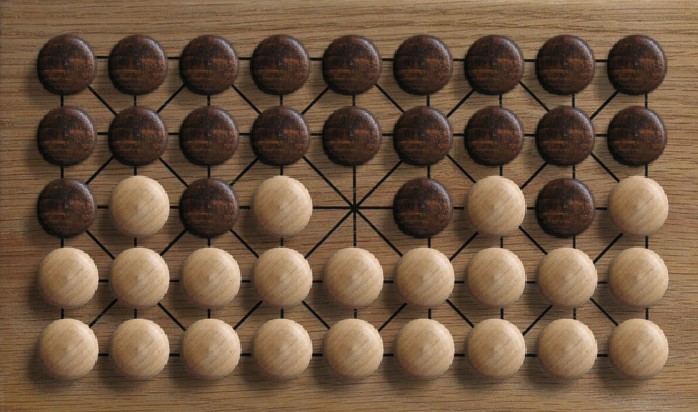
If you want a fun wham, bam, knockabout, piece taking, abstract game, then this is it. I like the innovative capture mechanics. However, I am yet to be convinced by it as a strategy game, but maybe . . .
Fanorona is very popular in Madagascar, dating from the 1600's. At the time of writing, it is one of the most popular games on Boardspace. I do not see why?! (Possibly because it is included as a mini-game in the Assassins Creed III video game?) The game starts on a very congested board, seen above, and the very first move must be a capture! Pieces can move to an adjacent position if there is a joining line. To capture a row of opponent's pieces you move towards or withdraw from that row. If a capture is possible it is compulsory, with a possible chain of optional follow on captures. The beginning of the game is carnage! To win, you must capture all of your opponents pieces, though most games are likely to end in a resignation before then. Here are the rules from Boardspace.
As the board clears of pieces, the game does become more strategic. However, most of my games are clear losses by then! I feel that, like chess, there is potentially a comprehensive opening theory which, if used, would lead to interesting middle games. However, I can find no reference to such opening knowledge. I personally like endgame analysis in all abstract games, but there is little motivation for study if you are thrashed by the middle game and endgames don't arise!
Cyningstan suggests "In the end game, the advantage of a single piece is not enough to bring about a win. When the board is nearly empty, an advisable tactic is to move diagonally when traversing the board; this ensures that pieces remain on squares with diagonal routes available to them." Wikipedia says that "In 2007, the game of Fanorona and smaller variants were solved weakly as a draw under perfect play. Both the moves f2-e3A and d3-e3A lead to a draw." More detail can be found from Maastricht University.
Comments
DrDave
20 January 2022 - 11:11am
Permalink
Both the moves f2-e3A and d3-e3A lead to a draw.
Those are two of the only three possible opening moves!
David Beckwith
21 January 2022 - 11:32am
Permalink
Two of the only three possible opening moves??
Surely, there are 5 opening moves, the other 3 being
d3-e3W
d2-e3A
e2-e3A